










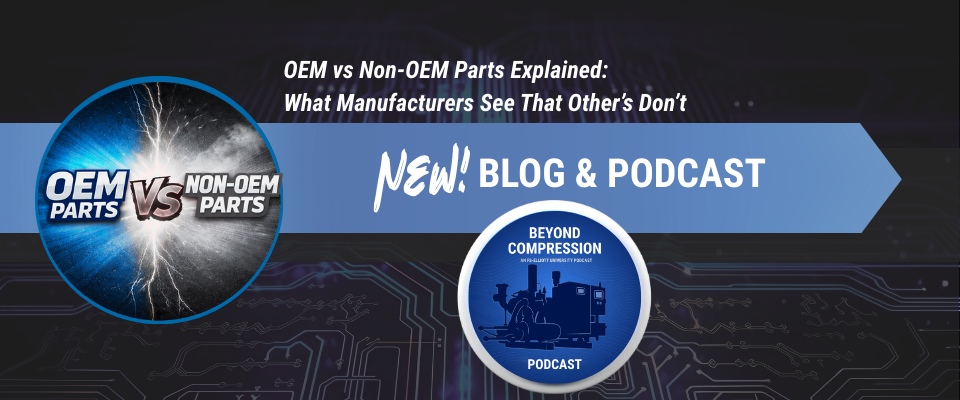
OEM vs Non-OEM Parts Explained: What Manufacturers See That Others Don’t
1月 15, 2026
1. The Reverse Engineering Gap
- The challenge: Third-party manufacturers do not have access to original engineering drawings, material specifications, tolerance stacks, balance requirements, or manufacturing processes.
- The consequence: Even minor deviations in geometry, material composition, surface finish, or balance can introduce performance losses, accelerated wear, or reliability issues that may not be immediately visible—but emerge over time.
2. The Hidden Cost of a “Lower Price”
- Performance trade-offs: Non-OEM parts may not meet the same quality standards, certifications, or safety margins as OEM components.
- Efficiency Impact: In specialized equipment, such as centrifugal air and gas compressors, small deviations can result in measurable efficiency losses and increased power consumption.
Case in point:
3. OEM Support and Warranty Protection
When OEM Parts Matter Most
OEM parts are especially critical in applications involving:
- High-speed rotating equipment
- Energy-intensive or continuous processes
- Semiconductor, pharmaceutical, and food & beverage production
- Equipment operating near design limits
- Machines still under OEM warranty
The Verdict
Choosing OEM parts isn’t just a matter of quality, it’s a decision about reliability, accountability, and long-term performance.
Every genuine OEM part is engineered to original specifications and backed by the same standards, testing, and support infrastructure as the equipment itself. It integrates seamlessly with OEM service programs and is supported by experts who understand the system in its entirety.
While aftermarket parts may appear attractive for short-term savings, particularly on older equipment, Genuine OEM Parts are the only way to ensure:
- Perfect Fitment: No modifications or adjustments required
- Maximum Durability: Designed to match the life and performance of the original
- Protected Performance: No disputes over part origin or coverage
- Operational Certainty: Access to OEM engineering and service expertise
- Traceability: Complete documentation for compliance, service history, and warranty validation
| Criteria | OEM Parts | Non-OEM Parts |
|---|---|---|
| Design Criteria | Original engineering specifications | Reverse engineered |
| Materials | OEM-grade, tested materials | Varies by supplier |
| Tolerances | Exact | Approximate |
| Efficiency Impact | Designed for peak performance | Can reduce output |
| Warranty | Fully supported | May affect OEM warranty coverage |
| Risk Profile | Predictable | Varies by supplier |
Your equipment represents a significant investment. Protecting its performance and longevity should never be a compromise.
Protect Your Compressor with Genuine OEM Parts
Connect with our team to explore how genuine FS-Elliott OEM replacement parts can help maintain compressor performance, reduce the risk of unplanned downtime, and support long-term equipment reliability.
Frequently Asked Questions
Do non-OEM parts always void the warranty?
Not always, but they can. If a non-OEM part contributes to a failure, warranty coverage may be impacted. These parts may also lack the same safety and validation standards, increasing operational risk.
Are non-OEM parts ever acceptable?
In some cases, for low-risk, non-critical components on legacy equipment. Even then, efficiency, reliability, safety, and long-term cost should be carefully evaluated.
Why are OEM parts more expensive?
OEM parts reflect the cost of original engineering, material validation, manufacturing controls, testing, certification, and long-term support. The price includes assurance of performance, reliability, and compatibility, not just the cost of production.
Can non-OEM parts reduce compressor efficiency?
Yes. Small differences in geometry, clearances, surface finish, or material properties can disrupt airflow and performance. In high-speed centrifugal compressors, these deviations can reduce efficiency, increase power consumption, and accelerate wear over time.
How can I tell if a part is truly OEM?
Genuine OEM parts are supplied through authorized channels and include proper documentation, traceability, and part identification. Parts sold outside authorized networks may lack verification, material certification, or design validation, even if they appear identical.
Do non-OEM parts increase long-term maintenance costs?
Often, yes. Shorter service intervals, unplanned downtime, and secondary damage frequently result in a higher total cost of ownership over time.
Why do non-OEM parts fail earlier?
Based on aftermarket inspections across multiple applications, non-OEM components are more frequently associated with early-life failures, often within the first 12–18 months, due to differences in materials, tolerances, and validation testing.
YOU MAY ALSO LIKE
Continue Reading

How Compressed Air Impacts Product Quality and Efficiency in Automotive Manufacturing
Automotive manufacturing relies on compressed air at virtually every stage of production. From robotic assembly and paint operations to material handling and battery manufacturing, compressed air powers critical processes that keep production moving.
Polaris P650 DF Brochure
Maximize airflow and efficiency with FS-Elliott’s Polaris P650 DF (Double-Flow) centrifugal air compressor, delivering 10,000 to 20,000 CFM of ISO 8573-1 Class 0 oil-free air. Our brochure highlights its innovative dual-inlet design, compact footprint, advanced technologies, and performance features designed to support reliable, energy-efficient operation.

Polaris P750 Brochure
Experience high-capacity, energy-efficient performance with FS-Elliott’s Polaris P750 centrifugal air compressor, delivering up to 22,100 CFM of ISO 8573-1 Class 0 oil-free air. Our brochure highlights its compact design, advanced technologies, performance capabilities, and innovative features designed to support reliable operation and reduced lifecycle costs.

FS-Connect Brochure
Stay connected to your centrifugal compressors with FS-Elliott’s FS-Connect remote monitoring solution. Our data sheet highlights real-time monitoring, performance trending, notifications, and available subscription options designed to improve equipment visibility, support proactive maintenance, and minimize unplanned downtime.