











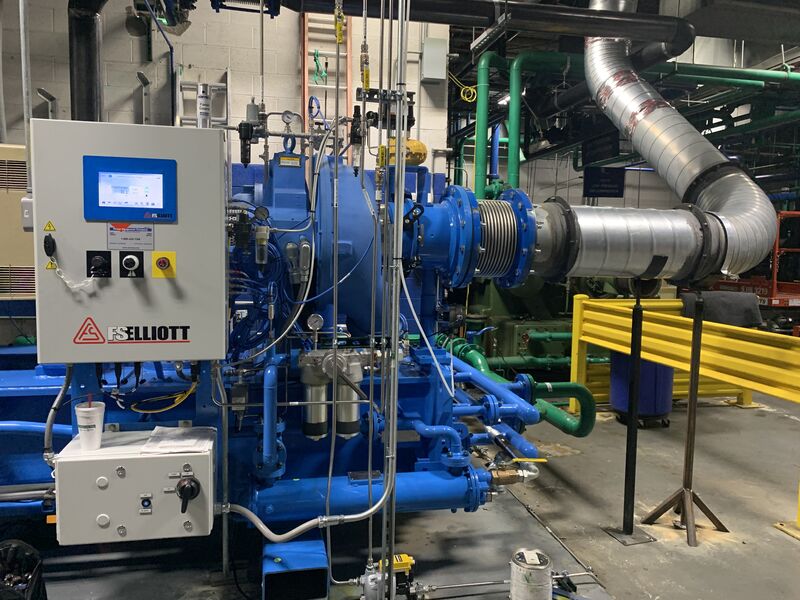
Centrifugal compressors provide compressed air for a wide range of applications across various industries, including food and beverage processing, petrochemical plants, and oil refineries. While flow and pressure requirements often drive initial selection, site conditions ultimately determine how the compressor performs in real operation.
Ambient conditions such as temperature, pressure, and humidity directly affect air density, which in turn impacts mass flow, power consumption, and achievable capacity.
When these inputs are inaccurate or overly conservative, the result is often an improperly sized machine, either oversized with unnecessary energy consumption or undersized with performance limitations.
Key site conditions to evaluate:
- Ambient temperature
- Ambient pressure
- Relative humidity
- Coolant supply temperature
Accurate inputs allow engineers to size a compressor that performs consistently across seasonal and operating variations while avoiding unnecessary capital and operating costs.
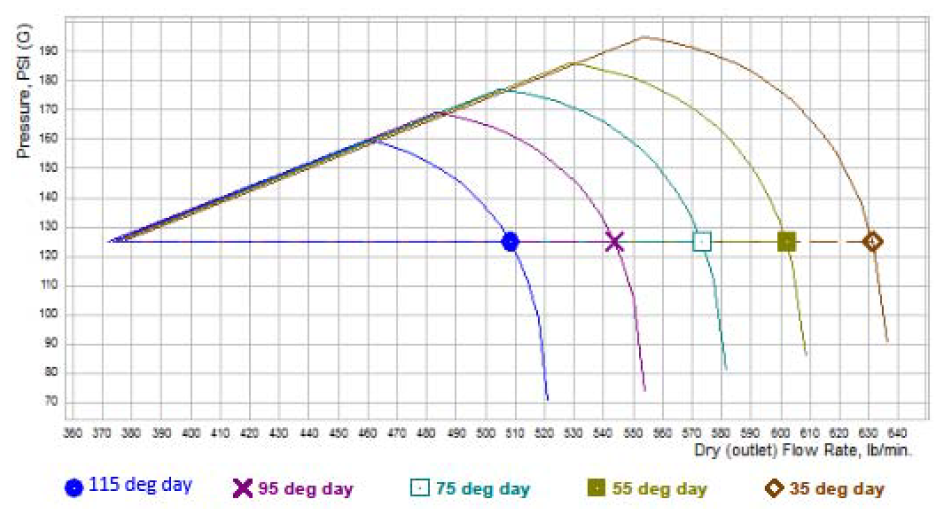
Ambient temperature has the most significant impact on compressor performance because it directly influences air density.
At lower temperatures, air becomes denser, allowing the compressor to process more mass flow. At higher temperatures, air density decreases, reducing the compressor’s maximum capacity.
In practical terms:
- Cold conditions → higher capacity
- Hot conditions → reduced capacity
This variation requires compressors to operate across a range of conditions throughout the year. Systems equipped with Inlet Guide Vanes (IGVs) adjust flow during colder conditions by reducing inlet air, allowing the compressor to maintain efficiency without overproducing.
Seasonal variation is a critical consideration. A system sized only for peak summer conditions without accounting for normal operating ranges may result in unnecessary energy consumption during most of the year.
Pressure vs Flow at Various Ambient Air Temperatures
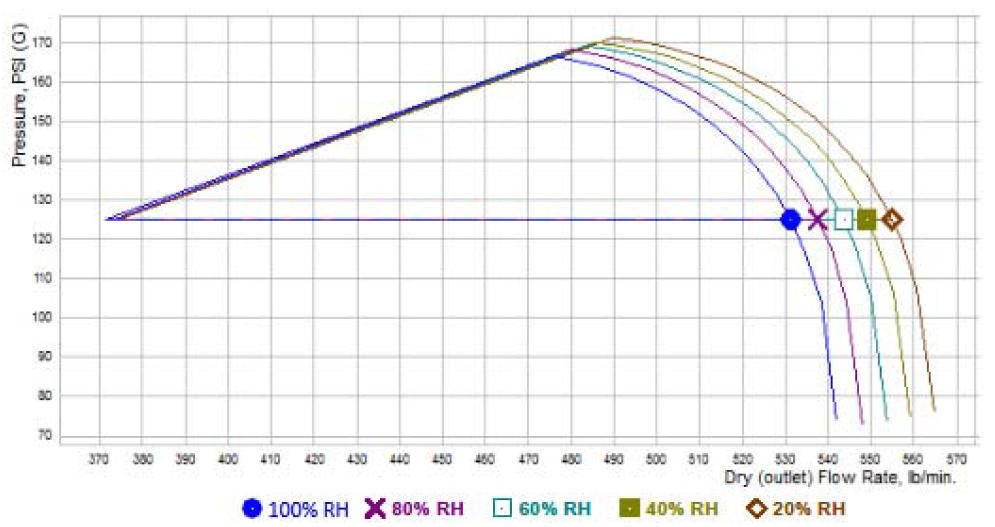
Relative humidity also affects air density, though to a lesser extent than temperature.
Higher humidity reduces the amount of dry air available for compression, which lowers mass flow and system capacity. In high-humidity environments, this can become a limiting factor when operating near capacity thresholds.
For example:
- As relative humidity increases, available mass flow decreases
- At high humidity levels, compressors may not meet peak demand without proper sizing
While humidity does not typically drive selection on its own, it should be included in performance calculations, especially in coastal or high-moisture environments.
As with temperature, overly conservative assumptions can result in oversizing and unnecessary cost.
Pressure vs Flow at Various Relative Humidity Values
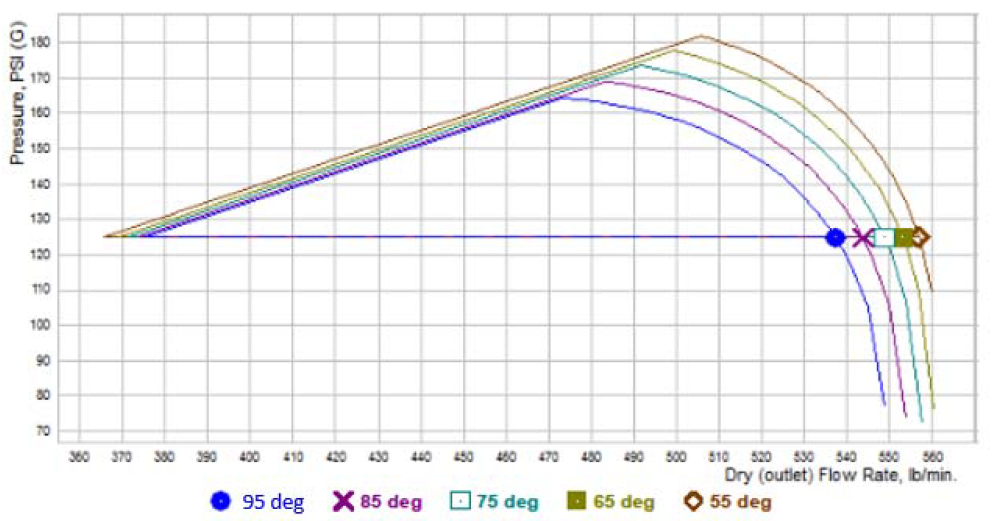
Coolant supply temperature plays a critical role in intercooler performance and overall compressor efficiency.
The effectiveness of cooling is measured by the approach temperature, or the difference between the outlet air temperature and the coolant inlet temperature. When coolant temperatures increase, the air entering the next compression stage remains hotter.
This leads to:
- Reduced air density between stages
- Lower mass flow capacity
- Increased energy demand
As coolant temperature rises, the compressor must work harder to achieve the same output.
Accurate coolant temperature inputs are essential for proper sizing. Underestimating this value can result in performance shortfalls, while overestimating it can drive unnecessary system cost.
Pressure vs Flow at Various Coolant Temperatures
The goal of compressor sizing is not to design for rare extremes, but to ensure stable performance across typical operating conditions.
A properly sized compressor should:
- Meet demand during peak temperature and humidity periods
- Operate efficiently during normal conditions
- Adjust output using control features such as IGVs
- Avoid excessive blow-off or throttling
Providing accurate, site-specific data ensures that the system can:
- Turn up during hot, humid conditions
- Turn down during cooler periods
- Maintain efficiency throughout the year


How Compressed Air Impacts Product Quality and Efficiency in Automotive Manufacturing
Automotive manufacturing relies on compressed air at virtually every stage of production. From robotic assembly and paint operations to material handling and battery manufacturing, compressed air powers critical processes that keep production moving.
Polaris P650 DF Brochure
Maximize airflow and efficiency with FS-Elliott’s Polaris P650 DF (Double-Flow) centrifugal air compressor, delivering 10,000 to 20,000 CFM of ISO 8573-1 Class 0 oil-free air. Our brochure highlights its innovative dual-inlet design, compact footprint, advanced technologies, and performance features designed to support reliable, energy-efficient operation.

Polaris P750 Brochure
Experience high-capacity, energy-efficient performance with FS-Elliott’s Polaris P750 centrifugal air compressor, delivering up to 22,100 CFM of ISO 8573-1 Class 0 oil-free air. Our brochure highlights its compact design, advanced technologies, performance capabilities, and innovative features designed to support reliable operation and reduced lifecycle costs.

FS-Connect Brochure
Stay connected to your centrifugal compressors with FS-Elliott’s FS-Connect remote monitoring solution. Our data sheet highlights real-time monitoring, performance trending, notifications, and available subscription options designed to improve equipment visibility, support proactive maintenance, and minimize unplanned downtime.