









Passer au contenu principal

FS-Elliott

FSE Logo

Beyond the Price Tag: The Long-Term Cost of Compressed Air

février 18, 2026
Beyond Compression Blog Episode 3
Compressed air is one of the most widely used utilities in industrial operations, and one of the most expensive. While the upfront cost of a compressor often gets the spotlight, it’s only a small part of the total cost of ownership. The real expenses come from energy consumption, system inefficiencies, maintenance practices, consumables, and downtime. 
A modern approach to compressed air looks beyond the machine itself. It focuses on how the entire system operates over time, and how small inefficiencies quietly drive big costs.
 
 
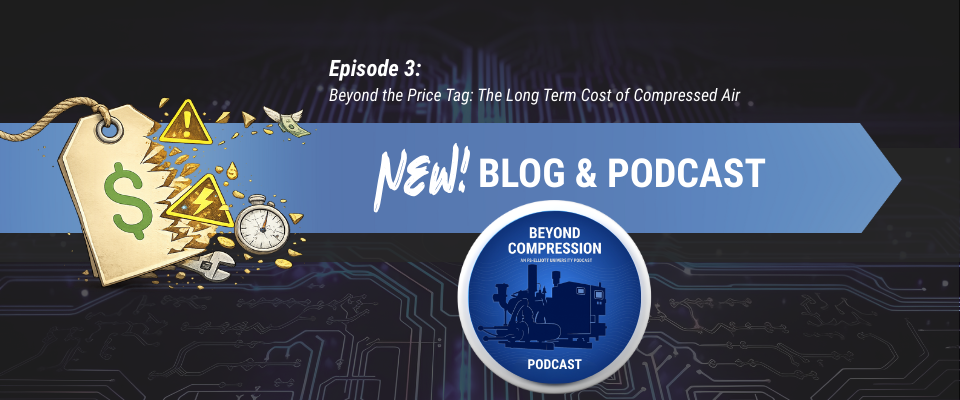
Prefer to listen instead? Tune into our podcast to learn more about the long-term cost of compressed air.

Why Compressed Air Costs More Than You Think


In many facilities, energy accounts for 70–80% of total compressed air costs. Factors such as operating pressure, partial-load efficiency, control strategy, and run time all play a role. Even minor inefficiencies, like running at higher pressure than required, can significantly increase energy consumption.
 

A general rule of thumb:

Every 1 psi increase in system pressure raises energy use by about 0.5%.

The Importance of System Audits


A compressed air system audit is the first step toward understanding where money is being wasted. Audits evaluate energy usage, air leaks, pressure levels, air quality, and equipment condition. More importantly, they establish a data-driven baseline that reveals inefficiencies that aren’t obvious during daily operation.
 
This insight allows facilities to prioritize improvements that deliver real cost savings.

Key Drivers of Long-Term Cost


Several factors consistently impact compressed air operating costs:
  • Energy efficiency: Compressors are most efficient near full load. Partial-load operation increases energy use per unit of air.
  • Motor performance: Motors operating outside their optimal range consume more energy and wear faster.
  • Over-pressurization: Excess pressure increases energy use, leakage, and equipment stress.
  • Maintenance strategy: Predictive, condition-based maintenance reduces downtime and unnecessary service.
  • Consumables and air quality: Filters, lubricants, and separators affect pressure drop, energy use, and contamination risk.
  • Condensate management: Improper handling of oil-contaminated condensate adds cost and environmental risk.

Technology’s Role in Cost Control


Modern compressed air systems increasingly rely on real-time monitoring and IIoT connectivity. These tools provide visibility into performance trends, enable faster diagnostics, and support smarter operational decisions, especially across multi-site operations.
 
Better data leads to better energy management, improved reliability, and stronger ESG performance.

Bottom Line


Compressed air doesn’t have to be a hidden cost. By understanding system behavior, monitoring performance, and addressing inefficiencies proactively, organizations can reduce operating expenses, improve reliability, and extend equipment life. 
 
When managed strategically, compressed air becomes an asset, not a liability.
 
Whether you prefer listening or reading, the goal is the same: better system decisions. 
 
Hear lessons learned from field engineers in Episode 3 of Beyond Compression, or dig into the data behind compressed air costs in our Hidden Costs of Air Compressor Operation white paper, covering audit results, energy profiles, and system performance benchmarks.

Reduce the Long-Term Cost of Compressed Air

Connect with our team to explore how energy-efficient centrifugal compressors, advanced controls, and proactive maintenance strategies can help reduce operating costs and improve compressed air system reliability.

Frequently Asked Questions


Because most of its cost comes from energy use over time, not the initial equipment purchase. Inefficiencies compound quickly.

A lot. Running even 10–20 psi above what’s required can increase energy consumption by 5–10% or more.

Yes. Audits uncover inefficiencies that typically go unnoticed and provide a roadmap for targeted improvements.

Fewer consumables, lower contamination risk, reduced condensate treatment costs, and improved product protection in sensitive applications.

Real-time data helps identify abnormal operation, optimize loading, prevent failures, and reduce unnecessary energy use.

YOU MAY ALSO LIKE

Continue Reading


Product Brochures
Barbara Myers

Polaris P650 DF Brochure

Maximize airflow and efficiency with FS-Elliott’s Polaris P650 DF (Double-Flow) centrifugal air compressor, delivering 10,000 to 20,000 CFM of ISO 8573-1 Class 0 oil-free air. Our brochure highlights its innovative dual-inlet design, compact footprint, advanced technologies, and performance features designed to support reliable, energy-efficient operation.

Read More »
Polaris P750 brochure featured image
Product Brochures
Barbara Myers

Polaris P750 Brochure

Experience high-capacity, energy-efficient performance with FS-Elliott’s Polaris P750 centrifugal air compressor, delivering up to 22,100 CFM of ISO 8573-1 Class 0 oil-free air. Our brochure highlights its compact design, advanced technologies, performance capabilities, and innovative features designed to support reliable operation and reduced lifecycle costs.

Read More »
FS-Connect brochure featured image
Product Brochures
Barbara Myers

FS-Connect Brochure

Stay connected to your centrifugal compressors with FS-Elliott’s FS-Connect remote monitoring solution. Our data sheet highlights real-time monitoring, performance trending, notifications, and available subscription options designed to improve equipment visibility, support proactive maintenance, and minimize unplanned downtime.

Read More »

Connexion

Suivi à distance FS-Connect

Visualisez les données de fonctionnement du compresseur et surveillez ses performances à distance.

Portail FS-Elliott

Accédez aux ressources des partenaires de canal autorisés et des membres de l’équipe interne.