FS-Elliott

FSE Logo

How to Prevent Your Air Compressor Motor from Overheating This Summer

June 18, 2025
Sun shining on motor

Reduce the risk of failure in your centrifugal air compressor by thoroughly checking your motor this summer season. High temperatures and increased usage during warmer months can strain motor components, making it essential to stay vigilant. Below, we explore the most common causes of air compressor overheating and what you can do to prevent costly damage and downtime.

Why Summer Poses a Greater Risk for Air Compressor Overheating


Summer heat can put extra stress on your compressed air system, especially the air compressor motor. As ambient air temperatures rise, it becomes harder for the system to stay within safe operating limits, increasing the risk of air compressor overheating.

Without proper ventilation, the air compressor temperature can climb quickly, causing the motor to work harder and wear out faster. That’s why seasonal maintenance is so important; just a few degrees can make a big difference in performance and reliability.

What Causes Air Compressor Overheating?


Overheating of any air compressor type can be caused by a range of issues, including:

Improper Cooling 

Some common causes of an air compressor’s motor overheating are improper ventilation, high ambient air temperature, low suction pressure, and excessive wear and tear.  If any of these factors prevent the motor from cooling down properly, it will become increasingly hotter over time.

Electrical Problems 

Electrical problems such as voltage imbalance and surges can happen quickly without notice and wreak havoc on your compressed system, potentially causing an overheated motor. For this reason, it is also essential to have a healthy starter for your compressor to avoid electrical issues. A well-maintained starter will ensure the proper protection of the motor, thus reducing the chances of any surge or voltage imbalance that could occur. 

Misalignment 

All compressor motors produce vibrations as they operate; however, motor misalignment can create excessive vibrations and cause friction between components. The friction of components will begin to wear down and place extra load on the motor, drawing excessive current and significantly increasing the air compressor temperature.

Incorrect Motor Size

When considering the size of the motor, it is important to account for the site conditions and the size of your air compressor. A motor that is too small will operate in an overload condition, and the motor will overheat.

Ambient Air Temperature

Motors rely on circulated air for the proper cooling of the motor windings and bearings. Motors have a rated ambient air temperature of 40°C (104°F). If the motor is located in an area where the surrounding air temperature is greater than 40°C (104°F), the motor will experience higher operating temperatures.  

Incorrect NEMA Insulation Class

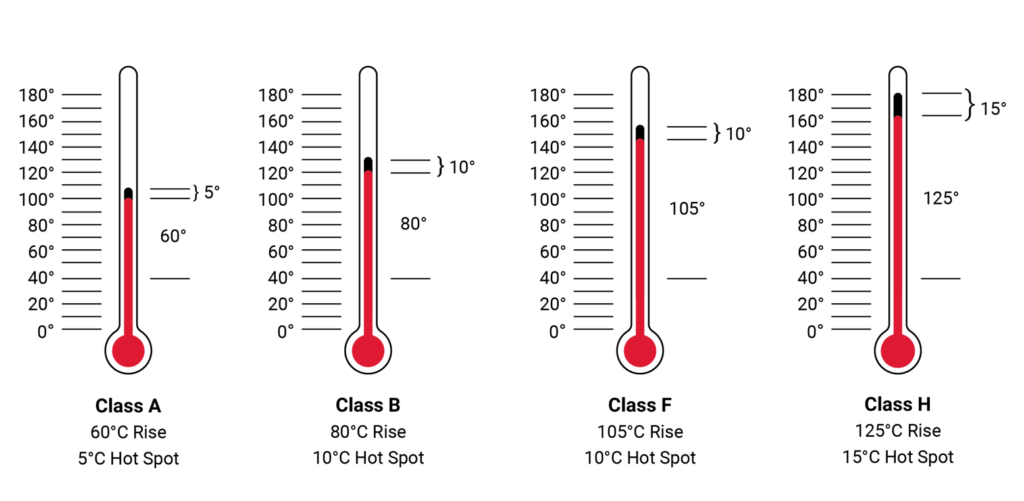
When looking at which NEMA insulation class to choose, it is critical to select the one that is right for your compressor’s motor along with site conditions. Failing to do so can result in overheating and a shortened life expectancy for the motor, which could lead to an unexpected temporary shutdown of your business. The motor winding insulation, which protects the conductive wires wrapped around the stator, can break down at temperatures past their maximum limit (see chart below). A deteriorated point in the insulation will result in an electrical short of the windings. Knowing the temperature rise within your motor, along with the ambient temperature of your plant, will allow you to determine which insulation class is best. Most motors are equipped with Class F insulation. 

Temperature Chart

Class A:

  • Maximum Temperature Rise: 60°C
  • Hot-Spot Over Temperature Allowance: 5°C
  • Maximum Winding Temperature: 105°C

Class B:

  • Maximum Temperature Rise: 80°C
  • Hot-Spot Over Temperature Allowance: 10°C
  • Maximum Winding Temperature: 130°C

Class F:

  • Maximum Temperature Rise: 105°C
  • Hot-Spot Over Temperature Allowance: 10°C
  • Maximum Winding Temperature: 155°C

Class H:

  • Maximum Temperature Rise: 125°C
  • Hot-Spot Over Temperature Allowance: 15°C
  • Maximum Winding Temperature: 180°C


FS-Elliott’s Scheduled Maintenance Guidelines will provide the necessary instructions to follow on quarterly, semi-annually, annually, and 3-year intervals for your motor:

  • Perform driver checks annually.
  • Inspect main drive coupling annually.
  • Check lubrication of drive motor bearings quarterly.
  • Check lubrication of auxiliary oil pump motor quarterly.

5 Things to Do If Your Air Compressor Motor Overheats


Even with regular maintenance, issues can still arise, especially during the hotter months when demand is high and cooling systems are pushed to their limits. If you notice signs of air compressor overheating, it’s important to act quickly to prevent permanent damage.

Why Work with FS-Elliott?


Working with FS-Elliott means having access to expert advice, OEM parts, and a maintenance schedule tailored to your specific compressor system. Our service team understands the intricacies of centrifugal compressors and can help you avoid the dangers of elevated air compressor temperature and other heat-related failures.

Protect Your Compressor Motor from Overheating

Connect with our team to explore how proper motor maintenance, ventilation, and cooling practices can help prevent overheating, reduce unplanned downtime, and support reliable centrifugal compressor performance during hot weather.

YOU MAY ALSO LIKE

Continue Reading


Product Brochures
Barbara Myers

Polaris P650 DF Brochure

Maximize airflow and efficiency with FS-Elliott’s Polaris P650 DF (Double-Flow) centrifugal air compressor, delivering 10,000 to 20,000 CFM of ISO 8573-1 Class 0 oil-free air. Our brochure highlights its innovative dual-inlet design, compact footprint, advanced technologies, and performance features designed to support reliable, energy-efficient operation.

Read More »
Polaris P750 brochure featured image
Product Brochures
Barbara Myers

Polaris P750 Brochure

Experience high-capacity, energy-efficient performance with FS-Elliott’s Polaris P750 centrifugal air compressor, delivering up to 22,100 CFM of ISO 8573-1 Class 0 oil-free air. Our brochure highlights its compact design, advanced technologies, performance capabilities, and innovative features designed to support reliable operation and reduced lifecycle costs.

Read More »
FS-Connect brochure featured image
Product Brochures
Barbara Myers

FS-Connect Brochure

Stay connected to your centrifugal compressors with FS-Elliott’s FS-Connect remote monitoring solution. Our data sheet highlights real-time monitoring, performance trending, notifications, and available subscription options designed to improve equipment visibility, support proactive maintenance, and minimize unplanned downtime.

Read More »

Log In

FS-Connect Remote Monitoring

View compressor operating data and monitor performance remotely.

FS-Elliott Portal

Access resources for authorized channel partners and internal team members.