











How to Calculate Your Compressed Air Energy Costs
April 30, 2025
Energy usage accounts for up to 75% of a compressed air system’s total life-cycle cost, making it the single most significant expense for facilities operating industrial air compressors. While the initial purchase and ongoing maintenance matter, understanding your compressed air energy consumption is essential for identifying savings opportunities and optimizing system performance.
This guide will show you how to calculate compressed air energy costs using a practical formula and explain how tools like AirCompare™ can automate the process for even deeper insights.
The Three Core Costs of Operating an Industrial Air Compressor
As outlined in our blog post, Compressed Air Costs: 7 Expenses That Every Manufacturer Should Track , the total cost to own and operate a compressor is generally organized into three groups – the initial capital investment or purchase price, energy usage and maintenance costs. The cost of energy is the single largest expense facing manufacturers who operate air compressors and can account for up to 75% of the compressor life-cycle cost. Because of this, understanding what you are spending to run your compressor is critical when looking for potential savings.
- Capital investment – The purchase price of the compressor
- Energy consumption – Ongoing power required to operate the compressor
- Maintenance and service – Replacement parts, labor, and system monitoring
Of these, energy expenses often account for more than 70% of total ownership costs over the compressor’s lifetime.
How to Calculate Compressed Air Energy Costs
Use the following formula to estimate the annual energy cost of your compressor:
Compressed Air Energy Cost Formula
- Rated Power (HP): Motor horsepower listed on the compressor’s nameplate
- Service Factor: This is how far above the rated horsepower a motor can operate without damaging the motor; this is located on the motor nameplate.
- Running Hours: Total annual hours the compressor is operating (e.g., 8,000 hrs/year)
- Energy Rate: Price per kWh from your utility provider (e.g., $0.12/kWh in the U.S.)
- Full Load Time: The fraction of time the compressor is at full load (1.0 = 100%)
- % Compressor Loaded: Average percentage the compressor is operating
- Motor Efficiency: Efficiency rating from the motor’s nameplate
Energy Cost Example for a 200 HP Air Compressor
Let us assume you are running a 200 hp compressor with a rated power of 215 that operates for 8,000 hours annually. It is fully loaded 85% of the time with a motor efficiency of 95% and unloaded the rest of the time (25% full-load and motor efficiency of 90%). The electric rate is $.12/kW.
The cost when your compressor is fully loaded: $137,766.57/year
The cost when your compressor is partially loaded: $6,415.60/year
Compressor Specifications:
- Rated Power: 215 HP
- Running Hours: 8,000 hrs/year
- Full Load: 85% of the time at 95% efficiency
- Part Load: 25% load at 90% efficiency
- Energy Rate: $0.12/kWh
Estimated Annual Energy Costs:
- Full Load Operation: $137,766.57/year
- Part Load Operation: $6,415.60/year
This illustrates how significant energy costs can become especially at higher horsepower levels. Accurately calculating these expenses is key to compressed air system optimization and life-cycle cost management.
Save Time with AirCompare™ – Compressor Life-Cycle Cost Calculator
Want a faster and more precise analysis? AirCompare simplifies energy cost calculations with a powerful life-cycle cost calculator tailored for industrial air compressors.
What You’ll Get with AirCompare:
Estimated energy and maintenance costs
Compressor performance benchmarking
Actionable insights into system efficiency
Optional full report for deeper analysis
Use AirCompare to find out how much your current compressor setup is costing you and where savings may be hiding.
Start Optimizing Your Compressor Costs Today
Calculating compressed air energy costs gives you the visibility needed to make smarter equipment and maintenance decisions. Whether you’re managing a single compressor or a fleet, tools like AirCompare can help you take control of your energy spending.
Reduce Your Compressed Air Energy Costs
Connect with our team to explore how evaluating compressed air energy consumption and optimizing compressor efficiency can help identify potential savings, reduce operating expenses, and improve long-term system performance.
YOU MAY ALSO LIKE
Continue Reading

How Compressed Air Impacts Product Quality and Efficiency in Automotive Manufacturing
Automotive manufacturing relies on compressed air at virtually every stage of production. From robotic assembly and paint operations to material handling and battery manufacturing, compressed air powers critical processes that keep production moving.
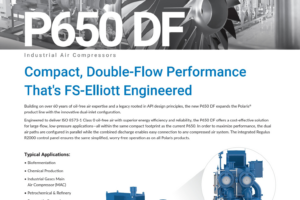
Polaris P650 DF Brochure
Maximize airflow and efficiency with FS-Elliott’s Polaris P650 DF (Double-Flow) centrifugal air compressor, delivering 10,000 to 20,000 CFM of ISO 8573-1 Class 0 oil-free air. Our brochure highlights its innovative dual-inlet design, compact footprint, advanced technologies, and performance features designed to support reliable, energy-efficient operation.

Polaris P750 Brochure
Experience high-capacity, energy-efficient performance with FS-Elliott’s Polaris P750 centrifugal air compressor, delivering up to 22,100 CFM of ISO 8573-1 Class 0 oil-free air. Our brochure highlights its compact design, advanced technologies, performance capabilities, and innovative features designed to support reliable operation and reduced lifecycle costs.
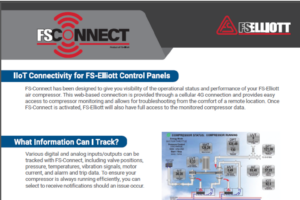
FS-Connect Brochure
Stay connected to your centrifugal compressors with FS-Elliott’s FS-Connect remote monitoring solution. Our data sheet highlights real-time monitoring, performance trending, notifications, and available subscription options designed to improve equipment visibility, support proactive maintenance, and minimize unplanned downtime.