






How FS-Elliott’s AirCompare Helps Make the Right Decision on Compressor Procurement
1月 12, 2023
Do You Evaluate Your Compressor Procurement by Lifecycle Cost (Cost of Ownership)?
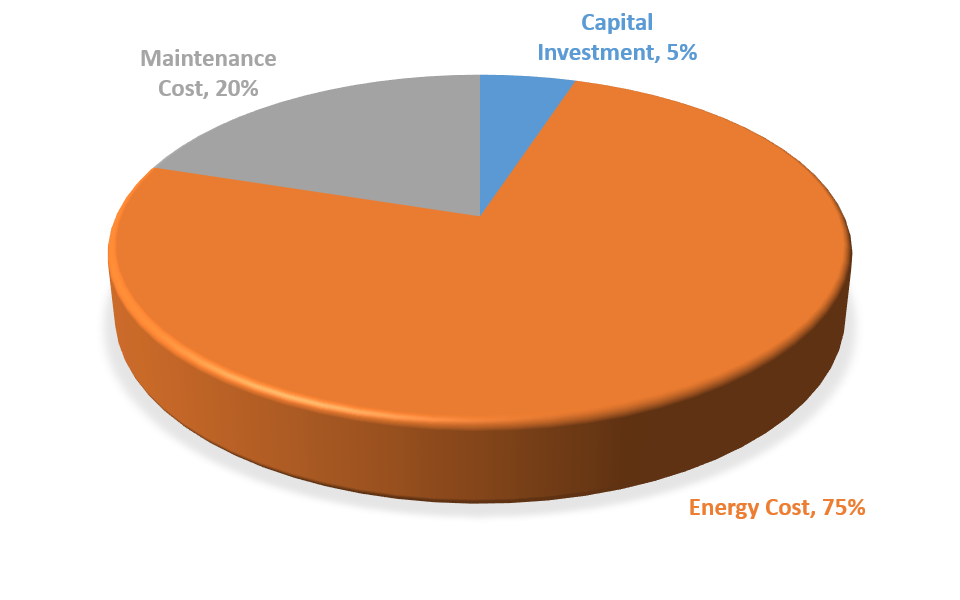
Capital investment is one of many costs when considering compressed air solutions. For a typical positive displaced air compressor, capital investment is less than 5% of the entire lifecycle cost, while energy and maintenance costs dominate operation costs. For a 500HP compressor system, you might see a 3% efficiency improvement, equating to an 11kW power reduction. This efficiency improvement can save you almost $12,000 yearly in net profits. As energy prices increase, performance efficiency is more significant to operation costs.
Energy-saving is more than saving money for factory operations, it is also about protecting, sustaining, and contributing to a better environment for us and our society. Environmental, Social, and Governance (ESG) initiatives are more critical in today’s daily production activities than before. Compressors consume energy from natural resources (primary energy). Even in the United States, the top three power generation sources are still 40% natural gas, 20% natural energy, and 19% coal. Natural gas and coal plants emit large amounts of carbon dioxide into the environment. High-efficiency compressors can help reduce emissions. Returning to our 500HP compressor system, a 3% efficiency improvement can reduce carbon dioxide emissions by up to 69,080 kg. Don’t underestimate your contribution! Even just hundreds of horsepower help more than you think.
However, compressor maintenance might be more painful than the cost of consumables. Oil-injected (oil-flooded) compressors have more lubricant consumption due to top-off carryover, and the oil removal system also has pressure loss equivalent to power consumption. Positive displacement compressors typically have more moving parts that meet the static parts, which can cause issues like pressure loss, leakage, or decreased efficiency. Replacing worn-out parts could lead to high costs if you want to avoid leakage or unexpected shutdowns. For example, oil-free screw compressors need the entire rotors replaced every 4-6 years because the Teflon coating wears out. In a worst-case scenario, compressor shutdowns mean lots of maintenance work, and maintenance indicates more downtime, which reduces operation availability.
FS-Elliott AirCompare program helps you analyze and compare the lifecycle cost to make the best decision for your purchase.
- Built-in CAGI datasheets of oil-injected (flooded) screw compressor and oil-free (dry) screw compressor models.
- FS-Elliott compressor performance is based on aero selection performance curves.
- Maintenance cost and efficiency deterioration are considered.
- A few steps of the AirCompare report to understand how FS-Elliott compressors help with life-cycle cost savings.
Here are additional resources to get you started
- Sample AirCompare report
- AirCompare case study to see how a manufacturer used AirComapre to save money at their facility.
To further support engineering decision-making, teams can use a compressor configuration tool like AeroSwap to evaluate alternative designs and performance scenarios under real operating conditions.
Make Smarter Compressor Investments with AirCompare
Connect with our team to explore how FS-Elliott’s AirCompare tool can help evaluate compressor options, compare energy consumption and lifecycle costs, and identify the most cost-effective compressed air solution for your operation.
YOU MAY ALSO LIKE
Continue Reading

How Compressed Air Impacts Product Quality and Efficiency in Automotive Manufacturing
Automotive manufacturing relies on compressed air at virtually every stage of production. From robotic assembly and paint operations to material handling and battery manufacturing, compressed air powers critical processes that keep production moving.

Types of Air Compressors & Their Applications
Explore different types of air compressors and their applications. Learn how flow, pressure, air quality, energy consumption, and maintenance requirements influence compressor selection and long-term operating costs.

How to Make Your Compressor Room Work for You
Learn how to optimize your compressor room to improve efficiency and reduce operating costs. Explore air audit preparation, practical improvement strategies, and how a beverage packaging plant met increased air demand on a limited budget.
Ethylene Plant Saves Over $100K Annually Through Compressed Air System Upgrades
A major ethylene production facility increased compressed air capacity and improved operational reliability through strategic system upgrades, achieving over $100,000 in annual energy and maintenance savings while meeting API 672 requirements.