











Compressed Air Costs: 7 Expenses That Every Manufacturer Should Track
Juli 11, 2025
A common mistake when purchasing an air compressor is choosing based on upfront capital cost alone, rather than considering the full cost of ownership. Because energy consumption and equipment maintenance can quickly drive up ownership costs, it is critical to understand what contributes to these expenses at your facility. To get started in your cost savings journey this year, you must first identify the following costs associated with your system.
Energy Costs
According to Energy Star, 76% an air compressor’s total lifetime cost comes from electricity use. This paired with the rising cost of energy means the goal at your facility should be delivering the required demand of air with the lowest amount of energy possible. To calculate compressed air energy costs you must first track rated power, motor efficiency, service factor, running hours, and energy rate.
- Power & Motor Efficiency
Motor efficiency rating refers to how much input electricity is converted into usable power for compression. Although there is a large range of efficiencies, generally the older and smaller the compressor motor is, the less efficient it is. As an example, a 100 HP premium efficiency motor typically has a motor efficiency rating at around 96%. Review your motor manufacturer’s datasheet to find this efficiency rating. - Service Factor
Service factor is a rating applied to a motor that determines how far it can operate over the rated horsepower without damaging the motor. For example, a service factor of 1.15 means the motor can operate at 15% over the rated horsepower, 1.20 equates to 20% over, and so on. It is not a good practice and potentially damaging to continuously operate motors above the rated load in the service factor area. When reviewing compressor capacities, bear in mind some manufacturers promote a full load that utilizes a portion of the service factor. - Running Hours
The running hours of your unit is the amount of time it is operating at a given power value, usually on a per year basis. This assessment tends to be grouped by labor shifts due to air demand changes between shifts. Continuous running machines typically operate 8,000 hours per year. - Energy Rate
The energy rate for your area may be obtained from your local power company. For reference, the average power cost per kW is .12 cents in the USA and .33 cents (USD) in Germany.
Maintenance Costs
- Consumables
Consumable products include anything that needs to be replaced at regular intervals such as filters, separators, and oil. The rate at which these need servicing can vary wildly based on the type of compressor you use. For compressors that are not oil-free, it is important to understand the downstream filter replacement costs as they can quickly add up over time and result in pressure drops that require additional energy to overcome. Oil-flooded machines also require oil to be changed every 6-12 months, while oil-free compressors can last 2-3 years on the minimal oil they need to operate. For operators looking to extend the time between changes, full synthetic oil is an ideal solution and offers less downtime and maintenance costs. - Condensate Removal
While both oil-flooded and oil-free compressors produce condensate, that of oil-flooded units makes a water/oil mixture which either must be properly disposed of or use a filtration system to separate the oil from the water. Condensate treatment alone can cost up to $50,000 per year and is something to take into consideration when making a compressor decision. - Airend Replacement
As compressors age, replacing the airend is often an option to improve overall performance. Depending on the technology, some airends are designed to last 3-5 years while others are rated for 20 years of continuous operation. Replacement costs can run up to 70% of the original purchase price, so assess repair vs. replace carefully.
Learn How to Uncover Hidden Costs at Your Facility
Download our “The Hidden Costs of Air Compressor Operation” white paper to learn about hidden compressed air costs that could be impacting your bottom line and how one company saved $125,000 annually by tracking and optimizing their compressed air system.
Reduce Your Compressed Air Operating Costs
Connect with our team to explore how energy-efficient centrifugal compressors, advanced control systems, and optimized compressed air solutions can help reduce energy consumption, lower operating costs, and improve long-term system reliability.
YOU MAY ALSO LIKE
Continue Reading

How Compressed Air Impacts Product Quality and Efficiency in Automotive Manufacturing
Automotive manufacturing relies on compressed air at virtually every stage of production. From robotic assembly and paint operations to material handling and battery manufacturing, compressed air powers critical processes that keep production moving.
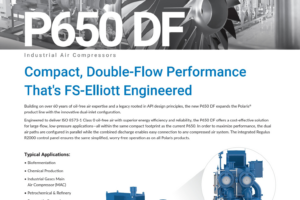
Polaris P650 DF Brochure
Maximize airflow and efficiency with FS-Elliott’s Polaris P650 DF (Double-Flow) centrifugal air compressor, delivering 10,000 to 20,000 CFM of ISO 8573-1 Class 0 oil-free air. Our brochure highlights its innovative dual-inlet design, compact footprint, advanced technologies, and performance features designed to support reliable, energy-efficient operation.

Polaris P750 Brochure
Experience high-capacity, energy-efficient performance with FS-Elliott’s Polaris P750 centrifugal air compressor, delivering up to 22,100 CFM of ISO 8573-1 Class 0 oil-free air. Our brochure highlights its compact design, advanced technologies, performance capabilities, and innovative features designed to support reliable operation and reduced lifecycle costs.
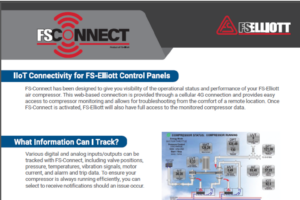
FS-Connect Brochure
Stay connected to your centrifugal compressors with FS-Elliott’s FS-Connect remote monitoring solution. Our data sheet highlights real-time monitoring, performance trending, notifications, and available subscription options designed to improve equipment visibility, support proactive maintenance, and minimize unplanned downtime.