










What’s the Difference Between Inlet Guide Vanes vs. Inlet Butterfly Valves?
يوليو 8, 2025
When evaluating the performance of a centrifugal compressor, few components have as much influence over energy efficiency and airflow control as the inlet control mechanism. Two common technologies, Inlet Guide Vanes (IGVs) and Inlet Butterfly Valves (IBVs), offer different approaches to managing inlet pressure and flow, each with its own impact on performance, energy use, and long-term operating costs.
While IBVs have historically dominated centrifugal compressor configurations, IGVs have steadily gained adoption in high-performance industrial applications.
What is an IGV Valve?
The full form of IGV is Inlet Guide Vane. In a centrifugal compressor, an IGV valve is an advanced inlet control mechanism that uses multiple adjustable, triangular vanes to direct and ‘pre-swirl’ incoming airflow. This aerodynamic design makes it significantly more efficient than traditional throttling methods.
How Inlet Butterfly Valves Regulate Flow
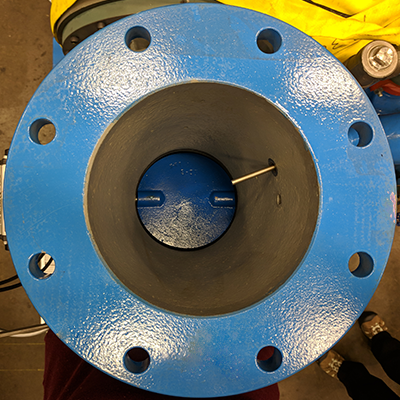
Inlet Butterfly Valves operate by directing the airflow into the first stage of compression in a straight-line path toward the impeller. The impeller then spins the air using power from the main driver, increasing air velocity and directing the flow into the diffuser portion of the compressor.
When partially closed, the IBV reduces inlet pressure by wasting some of the available static pressure, leading to unnecessary energy loss. As a result, the compressor must operate at a higher overall pressure ratio to maintain the same discharge pressure, making IBVs a less efficient option.
How do Inlet Guide Vanes Function?
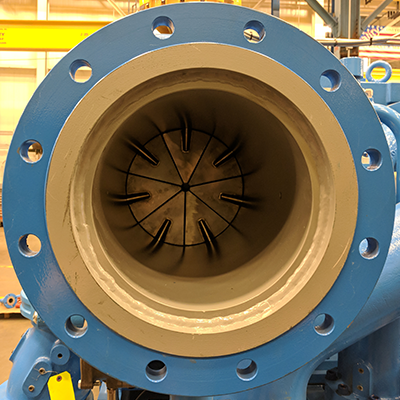
Unlike IBVs, IGVs use multiple triangular vanes to direct incoming airflow in a swirling motion, aligning it with the impeller’s rotation. This “pre-swirled” flow reduces the amount of work required from the main driver, improving efficiency. As the vanes close, the swirl effect increases, which reduces the load on the impeller and lowers power consumption without sacrificing discharge pressure. Because of this aerodynamic advantage, IGVs are significantly more efficient than IBVs during turndown and are ideal for facilities with fluctuating air demand or energy-efficiency goals.
Side-by-Side Comparison: IBV vs. IGV Performance
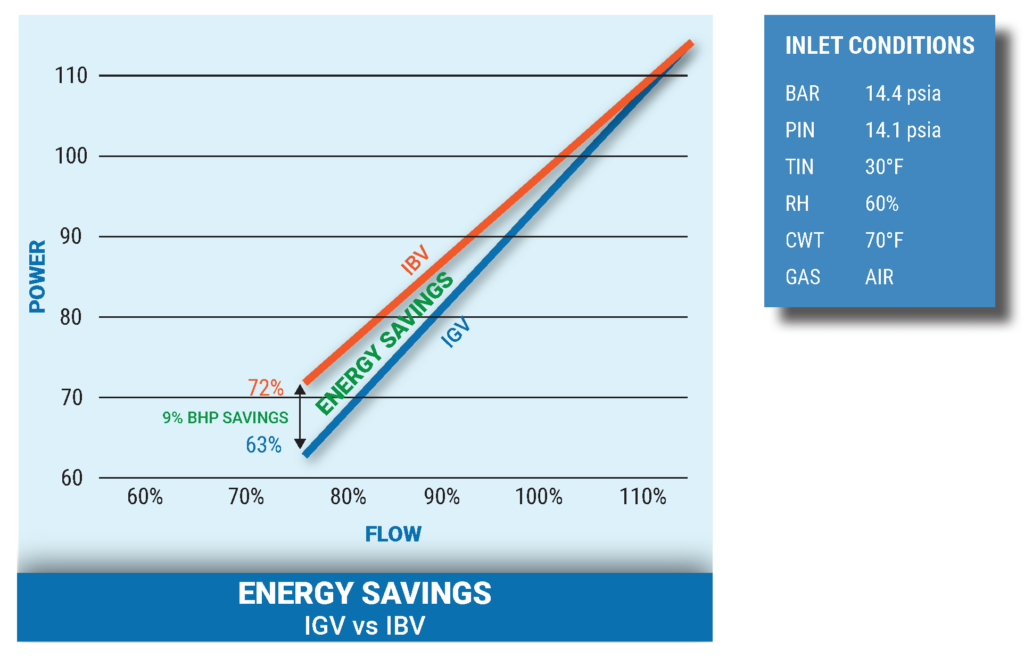
The main benefit of updating from an IBV to an IGV is the energy conservation gained from throttling the compressor. Compressors are designed to operate at the highest ambient temperature conditions, so when the temperature is lower, the ability to throttle extra air is paramount.
Consider a centrifugal compressor operating at 72% of its design flow:
| Feature | Inlet Butterfly Valve (IBV) | Inlet Guide Vane (IGV) |
|---|---|---|
| Airflow Direction | Directs air in a straight-line path toward the impeller. | “Pre-swirls” air to align with the impeller’s rotation. |
| Energy Loss | Wastes available static pressure; requires higher overall pressure ratio. | Reduces the aerodynamic workload on the main driver. |
| Power Consumption (at 72% flow) | Remains at 72% of design power. | Drops to roughly 63% of design power. |
| Best Used For | Standard systems with highly consistent flow demands. | Facilities with fluctuating air demand or energy-efficiency goals. |
That’s a 9% reduction in BHP, translating to thousands of dollars in annual energy savings in large-scale operations. In facilities running multiple compressors or high-horsepower units, this efficiency gap quickly compounds into a meaningful bottom-line impact.
Installation Considerations and Retrofit Potential
Upgrading from an IBV to an IGV may require moderate modifications depending on your compressor’s design, but the retrofit is typically straightforward for most FS-Elliott centrifugal units. IGVs are compatible with many variable inlet control systems and can be integrated with modern control panels to provide better responsiveness to real-time load changes.
Additionally, when paired with smart compressor control systems, IGVs allow more precise setpoint tuning, reduced cycling, and more consistent system pressures—further extending equipment life and reducing maintenance frequency.
Is an IGV Right for Your Centrifugal Compressor?
If your plant operates under varying loads, seasonal ambient conditions, or is actively pursuing energy reduction goals, an IGV upgrade may be a high-ROI improvement. FS-Elliott’s experts can assess your current inlet configuration and operating profile to determine whether switching from an IBV to an IGV will deliver measurable gains in energy performance and system reliability.
Optimize Compressor Efficiency with Advanced Inlet Controls
Connect with our team to explore how inlet guide vanes and inlet butterfly valves can help regulate airflow, improve energy efficiency, and optimize centrifugal compressor performance under varying operating conditions.
YOU MAY ALSO LIKE
Continue Reading

How Compressed Air Impacts Product Quality and Efficiency in Automotive Manufacturing
Automotive manufacturing relies on compressed air at virtually every stage of production. From robotic assembly and paint operations to material handling and battery manufacturing, compressed air powers critical processes that keep production moving.

Polaris P650 DF Brochure
Maximize airflow and efficiency with FS-Elliott’s Polaris P650 DF (Double-Flow) centrifugal air compressor, delivering 10,000 to 20,000 CFM of ISO 8573-1 Class 0 oil-free air. Our brochure highlights its innovative dual-inlet design, compact footprint, advanced technologies, and performance features designed to support reliable, energy-efficient operation.

Polaris P750 Brochure
Experience high-capacity, energy-efficient performance with FS-Elliott’s Polaris P750 centrifugal air compressor, delivering up to 22,100 CFM of ISO 8573-1 Class 0 oil-free air. Our brochure highlights its compact design, advanced technologies, performance capabilities, and innovative features designed to support reliable operation and reduced lifecycle costs.

FS-Connect Brochure
Stay connected to your centrifugal compressors with FS-Elliott’s FS-Connect remote monitoring solution. Our data sheet highlights real-time monitoring, performance trending, notifications, and available subscription options designed to improve equipment visibility, support proactive maintenance, and minimize unplanned downtime.